
Great Smoky Mountains National Park Guide

The Spring break trip that started it all: Great Smoky Mountains National Park
If I look back at my journey to visit all 433+ National Park sites, it was this to Great Smoky Mountains National Park that really set me off in earnest. At the time, I was just a dad taking his family on a vacation. I didn’t realize that it would crystalize into an obsession.
When I returned home, I found the National Parks Travelers Club, which opened my eyes to the incredible community of “stampers” out there. If you’re just starting your journey, check out my Ultimate NPS Passport Guide to see why this hobby is so addictive.

Springtime in the Great Smoky Mountains National Park: Wildflowers and History


Our trip was focused on the North Carolina side of the park, specifically the area around Cherokee and Bryson City.
Oconaluftee Visitor Center & Mountain Farm Museum
Our first stop was the Oconaluftee Visitor Center near Cherokee. Behind the visitor center is an amazing mountain farm museum. A group of historic log-cabin farmhouses were moved here in the 1950’s during the establishment of the park to preserve the structures. They have a number of living history exhibits that help educate how the mountain communities lived in and around the Smoky mountains.

Inside the Visitor center they had a ‘blooming board’, that showed all the spring wildflowers seen in the park up to that point.
We enjoyed seeing the wildflowers starting to come up and the little stream river that was next to the Oconaluftee River trail just behind the visitor center. We also saw many on our other hikes later that day. A great resource for hiking is this NPS trail map that shows the entire park.

Hiking Deep Creek: Waterfalls for the Whole Family
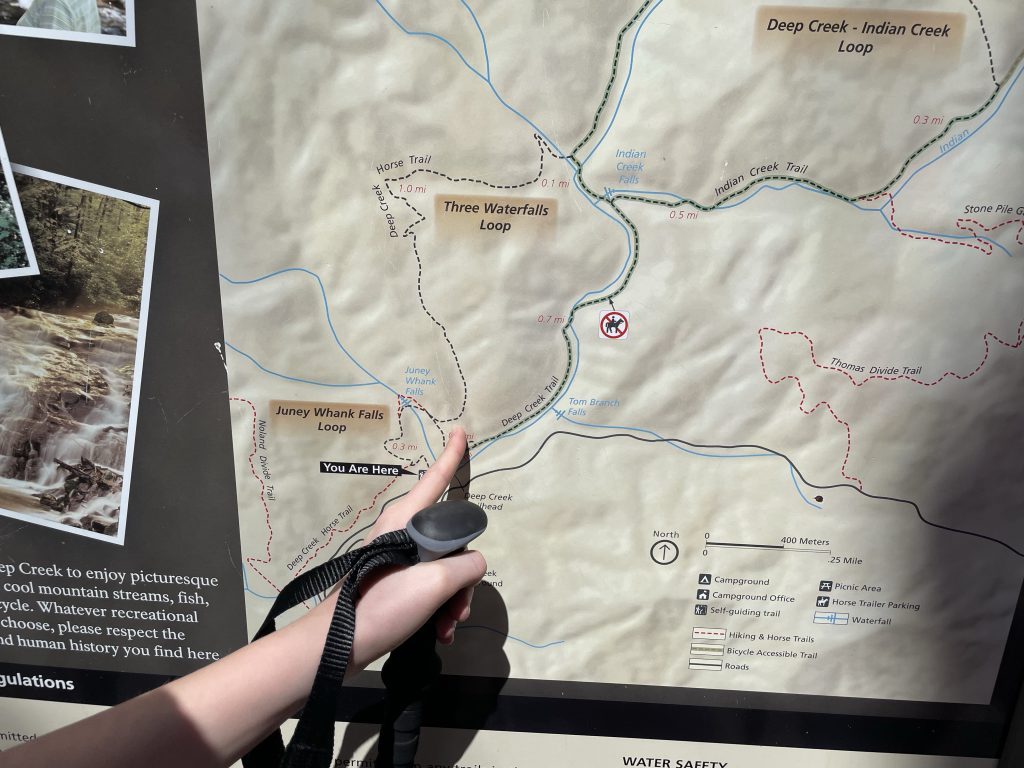
After stopping by the visitor center, we drove toward Bryson City to tackle the Deep Creek Loop — a 2.4-mile trail that features three waterfalls: Tom Branch Falls, Juney Whank Falls, and Indian Creek Falls. It’s a great family-friendly hike in the park. The trail has a few steeper sections in the middle but nothing that will stop a motivated 7-year-old. The wildflowers were going strong along the creek banks when we visited in early April, and the falls were running full from spring snowmelt.


Fontana Dam and Appalachian Trail
Deep in the National Park, we took a windy road to the Fontana Dam, which is the tallest concrete Dam east of the Rocky Mountains. A Project of the Tennessee Valley Authority (TVA), the dam was built in the early 1940’s and provided electricity not only to the local area but to the important Aluminum industry in the area to support WWII.


There is a nice little visitor center that provides background on the Dam, restrooms and nice little picnic areas. The Appalachian Trail crosses the top of the dam, and it actually has on the best stop over points for hikers. This is the same trail we’d later walk at Harpers Ferry.
Apparently, the Fontana Dam is the ‘Taj Mahal’ of showers and bathrooms for hikers on the AT. Nice facilities like this I am sure are very well received!

We of course had to walk across the dam, and it provides some striking views, and a little vertigo as you look over the edge.
Road to Nowhere in Great Smoky Mountains National Park
West of Bryson City, a road called Lake View drive continues into the National Park and even has a tunnel going through the mountain and then just stops. After the Fontana Dam was built and flooded the area, this promised road was started in the 60’s but was halted due to a number of environmental reasons and the ‘Road to Nowhere’ was born. Bryson City has a great webpage on details about the road to nowhere.
We hiked the Lakeshore Trail and looped back via the Goldmine Loop and Bypass Trail — about 3.4 miles total. The tunnel itself is the highlight: completely dark in the middle, cool even in spring, and genuinely eerie in the best way.


There are a number of pull outs along the 6-mile drive to view the scenery of Fontana Lake. A parking lot right before the tunnel is available for hikers as well. Bring a flashlight to walk through the 1-mile tunnel to the hiking trails on the other side!
Ziplining in the Rain: The “Tarzan Train” Experience
One interesting side trip we main was on the Great Smoky Mountain Railroad. This was tied to the Zip line tour we setup. We were able to ride the railroad out one way, and the zipline tour picked us up. After the zipline we were taken back to Bryson City.


It was overall very neat; the only thing was we were a bit unlucky with was the weather. All the train cars are open air and being the first week of April in the mountains, it was wet, rainy and cold. We layered up pretty good, so thankfully we were fine.
One note though. If you sign up for a zipline in brisk early April, and it is pouring down rain, you are still going ziplining. My son and I did the big zip lines, while my wife and daughter did the lines for younger kids. We all got soaking wet. It was a huge blast, and we still talk about it!
We only touched a small portion of the park, and surrounding area, but we did have a great time. There is certainly room to visit again, maybe later in the spring, to see a different view of the park and other areas.
Know Before You Go: The “Park it Forward” Change
Since our earlier visit, the park has implemented a major change that you need to be aware of. While there is still no entrance fee to drive through the park, as of 2023, you must have a parking tag to park for more than 15 minutes.
- Cost: $5 for a daily tag, $15 for a weekly tag.
- Critical Tip: You must print these tags at home before you arrive. The rangers do not accept digital versions on your phone, and they cannot print them for you at the visitor center.
- Exceptions: Interagency (America the Beautiful) passes do not cover this parking fee.
Frequently Asked Questions
Is there an entrance fee for Great Smoky Mountains National Park?
Technically, no. Due to historic land deeds, the park is prohibited from charging a traditional “per-person” entrance fee. However, a “Park it Forward” parking tag is now required for any vehicle parking for more than 15 minutes.
Where is the best place to get a passport stamp in the park?
The Oconaluftee Visitor Center (NC) and Sugarlands Visitor Center (TN) are the most reliable spots. Both have multiple stamps, including the Blue Ridge Parkway and Trail of Tears stamps.
Can I buy a parking tag at the visitor center?
Yes, but only at automated kiosks. It is highly recommended to purchase and print yours via Recreation.gov
before you arrive to avoid connectivity issues in the mountains.
Is the Deep Creek Loop trail good for kids?
Yes, it’s great for kids ages 7 and up. It features three waterfalls and plenty of spots to dip toes in the water. Just be prepared for a few steep sections in the middle of the loop.
What is the “Road to Nowhere”?
It is a 6-mile stretch of road (Lakeview Drive) that ends at a tunnel. It was intended to replace a road flooded by the creation of Fontana Lake but was abandoned due to environmental concerns. It’s now a popular spot for hiking and history.
When do the wildflowers bloom in the Smokies?
The peak “Spring Wildflower Pilgrimage” is usually in late April, but you can see Trillium, Phlox, and Violets starting as early as March in the lower elevations.
Is the Great Smoky Mountains Railroad open year-round?
They run most of the year, but the schedule varies. The “Canopy Tour” (ziplining) usually starts in April. Be prepared for cold, wet weather if you go in early spring!
Can I use my America the Beautiful pass for parking?
No. The “Park it Forward” program is a separate parking fee. Your national park pass covers entrance fees at other parks, but since GRSM doesn’t have an entrance fee, the pass doesn’t provide a discount on parking.
How many stamps are in Great Smoky Mountains National Park?
The Oconaluftee Visitor Center alone has several stamps including the park stamp, Blue Ridge Parkway, and Trail of Tears stamps. The park system-wide has over a dozen if you visit all visitor centers across both the NC and TN sides.
